
Have you noticed that when we talk about harmony in church, we always speak of it in a gentle, superficial way? Do mere smiles, handshakes and greetings of peace truly count as harmony?
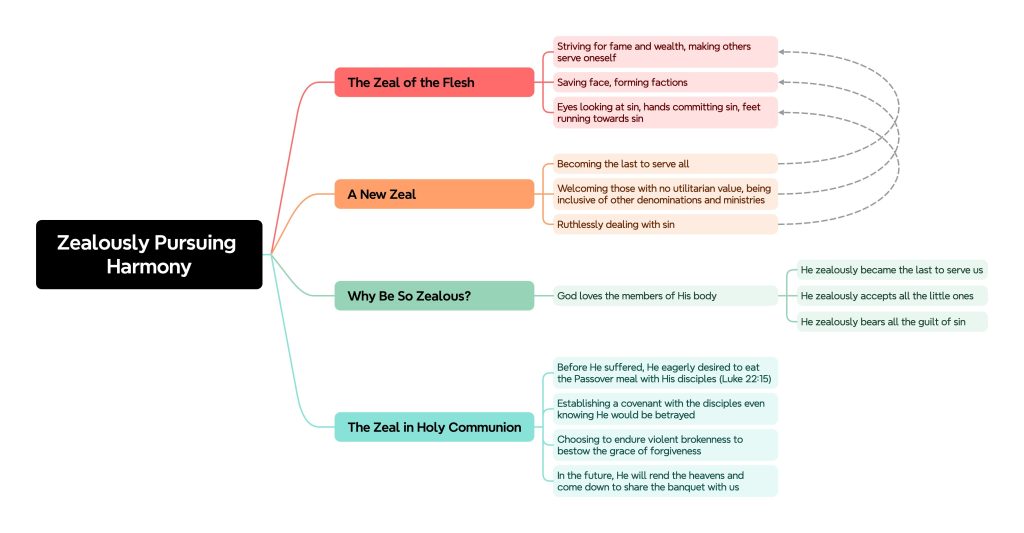
Today our topic is fervent harmony—a harmony that is anything but shallow.
What does fervent mean here? It means pursuing a goal wholeheartedly to an extent that seems reckless and even unreasonable to others.
In fact, the disciples were caught in such fervor back then. Let us see what they were so passionate about:
1. Verse 33: They were obsessed with vying for supremacy, craving fame and gain. Their aim was to make others submit to them, enjoy the fruits of others’ labor and bask in others’ admiration.
2. Verse 38: They were fixated on forming exclusive cliques, drawing lines between insiders and outsiders.
3. All these obsessions stemmed from their desire to gratify the flesh, satisfying the lust of the eyes and the lust of the flesh.
These three kinds of worldly fervor made them forget about harmony, ruining their fellowship with one another and even their relationship with Jesus.
First, let us talk about their rivalry for supremacy and worldly fame. Why did they argue over who was the greatest at that moment? Jesus had just taken three disciples up the mountain, making those three seem closer to Him. Meanwhile, the other nine disciples failed to cast out demons at the foot of the mountain, filling them with envy and jealousy. Besides, Jesus had twice foretold His coming suffering and death. The disciples could not comprehend the resurrection; they only heard about death. They thought their Lord was soon to die, so they began to jockey for status and rank among themselves.
They debated along the road, yet they never discussed the glory of Christ, the meaning of His death and resurrection, nor the true essence of fasting and prayer. All they argued about was who was greater than whom.
What was their motive for seeking high status? Nothing but self-indulgence—longing to be served and admired by others. As old Chinese sayings go: *To return home in fine clothes unseen is like walking in darkness in gorgeous robes; who will know your glory?* *An honest official can still amass great wealth in three years in office.* *People travel far to take official posts merely for food and clothing.* *Books hold houses of gold and fair maidens within.*
We can clearly see why the disciples were so consumed by worldly desires. They clung desperately to status, forgetting Christ beside them and all His teachings.
How did Jesus respond to this worldly mindset? He told them that whoever desires to be great must become a servant—a value totally opposite to the world’s standards.
The world scrambles for power and status because it believes resources are limited. Yet the kingdom of God operates by a different rule: God holds unlimited abundant resources, which He pours out freely to the needy and the humble. In God’s eyes, those who give to the poor are truly great. Those who truly know the richness of God’s kingdom and His sufficient provision will never chase fame and gain.
Then Jesus took a little child and said, whoever welcomes such a child in His name welcomes Him and the Father who sent Him.
A young child has no power, no influence, and cannot bring anyone status or benefits. They may even be ungrateful, offering no thanks no matter how much you do for them. Even a simple glance or word from them is precious enough.
Jesus meant true greatness lies not in associating with influential people, which only breeds jealousy instead of harmony. True greatness lies in building harmony between people and reconciling mankind to God. When you humble yourself to serve insignificant people who can repay you nothing, you manifest God’s abundant grace, following the example of the Creator who bestows blessings upon all who are in need.
Let us recall the story of Eric Liddell, the Scottish hero and protagonist of *Chariots of Fire*. As the 400-meter Olympic gold medalist in 1924, he turned down fame and glory and came to rural areas of Tianjin and Hebei in China as a missionary. When World War II broke out, he was imprisoned in the Weixian Internment Camp in Shandong in 1943. Shortages of supplies triggered constant conflicts among prisoners, yet he never revealed his identity as an Olympic champion. Instead, he served humbly: cleaning latrines, carrying coal, sharing food with the weak, organizing sports meetings and teaching chemistry to fellow inmates. Most touching of all, when the British government secured a prisoner exchange release quota for him, he gave this precious chance to a young child, and eventually passed away in the camp.
Many may think his deeds are foolish and reckless. What empowered him to do so? He beheld an even more fervent Savior: the Son of Heaven humbled Himself in human form, washed His disciples’ feet, and laid down His life on the cross solely to reconcile men to God. Eric Liddell longed to reveal Christ’s fervent love and lead more people to experience God-given harmony.
After Jesus taught these truths, John tried to justify the disciples’ actions, complaining that others broke their rules by casting out demons in Jesus’ name without following their group.
The disciples themselves had failed to cast out demons, yet they saw outsiders succeed in doing so in Christ’s name, which filled them with resentment and led them to stop that man. John’s words exposed his pride: he did not say those people did not follow Jesus, but that they did not follow *them*. His greatest concern was his own exclusive circle.
He could accept being ranked low within their group, but refused outsiders to join. These so-called outsiders were people who did not follow the disciples, not those who rejected Jesus. This was sectarian division. They regarded themselves as the most spiritual group and refused to accept others.
Jesus gave a thought-provoking reply: whoever gives even a cup of cold water to you because you belong to Christ will surely receive a reward. John was talking about cliques and excluding outsiders, yet Jesus spoke of giving water. He was warning the disciples that one day they would become outcasts in this world, despised and rejected for their faith. If anyone dared to treat them kindly and offer them help in such harsh times, they would earn eternal rewards, for such people truly strive for sincere harmony with fervent hearts.
In the 18th century, persecuted Christians fled to the territory of Count Zinzendorf in Germany. Though all believers, they came from different denominations, constantly arguing over whose theological views were correct and excluding those outside their own groups, filling the land with judgment, division and bitterness. Count Zinzendorf realized the community would collapse if they refused to lay down their inner pride. Instead of suppressing them with his noble authority, he made an extremely fervent decision: he abandoned his noble status and luxurious manor, and lived together with these poor refugees. He visited every household, served them humbly, listened to their grievances, and tearfully urged everyone to cast aside pride and reconcile with one another.
Count Zinzendorf truly devoted himself fervently to pursuing harmony. He understood that denominational boundaries meant nothing among fellow believers in Christ; revealing Christ’s fervent love was far more important.
Later Jesus spoke some harsh and startling words that seemed out of character: anyone who causes a little believer to stumble would be better off drowning in the sea with a heavy millstone around his neck. Why such stern words?
Jesus is fervently protective of His children, just as a hen fiercely guards her chicks. If new believers see strife for fame and cliques in the church, they will doubt God and stumble in faith. Jesus urged believers to pluck out their eyes, cut off their hands and feet to eliminate all sinful temptations. Just as people would amputate diseased limbs to save their bodies, we must cut off all sinful desires to protect the church, the body of Christ.
Here comes a vital question: must we literally do these things? Sin never originates merely from our eyes, hands or feet. Even without eyes or hands, sinful desires can still dwell in the heart. What Jesus emphasized here is our resolve to deal sternly with personal sin, for our sins harm not only ourselves but also fellow brothers and sisters in the church. It is just like sitting in a small boat: if you keep drilling holes under your seat, the whole boat will sink, and no one can stay safe.
If you think restraining sin is too painful, Jesus reminded us that such temporary hardship is nothing compared to the eternal fire and torment of hell.
Continuing the story of Count Zinzendorf: on May 12, 1727, he led all believers to sign a brotherly covenant, vowing to stop all judgment, stop imposing personal doctrines on others, confess their inner pride and humble themselves before one another. This was exactly cutting off the sinful “hands and eyes” that caused stumbling and division. Everyone repented tearfully before God, laying down denominational arrogance and choosing to be humble and lowly.
Shortly after the covenant was made, the Holy Spirit descended upon them during Holy Communion. All believers wept, embraced one another and fellowshipped late into the night. They felt as if they were dwelling in heaven, learning to love one another sincerely. This revival, known as the Moravian Pentecost, sparked over a century of uninterrupted round-the-clock prayer in church history.
The most inspiring testimony came from two young Moravian believers. Learning that countless black slaves in the West Indies lived in misery without hearing the gospel, while local slave owners banned missionaries from entering plantations, they made an astonishing decision: selling themselves into slavery. They willingly wore shackles and became servants of slaves, solely to preach the gospel to the most humble and neglected people. This is the ultimate fulfillment of being the least and servants of all.
Now you understand why we must pursue harmony with such fervor. Christ Himself is fervent in bringing us reconciliation: He humbled Himself to be the lowest servant to serve us, warmly accepts all weak and vulnerable believers, and bore the eternal hellfire punishment we deserved for our sins.
In our next sermon, we will talk about practical application: how to practice true harmony and offer ourselves as seasoned living sacrifices to God.
During today’s Holy Communion, please meditate on how the bread and wine reveal Christ’s fervent love for our reconciliation. The bread and wine are tangible manifestations of God’s word, fully displaying His passionate love to unite us with God and one another. Before His crucifixion, facing the most humiliating and painful death, Jesus earnestly desired to share the Passover feast with His disciples, as recorded in Luke 22:15. Even knowing He would be betrayed, He chose to break His body and shed His blood to establish a covenant of grace for mankind. He endured violent suffering to grant us forgiveness. He will one day descend from heaven once again to feast with us and drink new wine together. Is not such love the purest fervent devotion?
Let us pray together…